

Material

PTFE semi-finished products & finished parts
What is PTFE?
Polytetrafluoroethylene – PTFE – is a polymer made from tetrafluoroethylene. It is a semi-crystalline fluoropolymer with the highest degree of fluorination. Due to the molecular structures of the fluorine and carbon atoms, extremely strong bonds are formed, resulting in high resistance to almost all organic and inorganic chemicals. This in particular—combined with a wide operating temperature range and a very low coefficient of friction—has made PTFE the most widely used fluoropolymer. Today, it is indispensable in the core sectors of our economy.
The “discovery” of polytetrafluoroethylene in 1938 was essentially a coincidence: While attempting to synthesize an odorless, non-flammable, and non-toxic refrigerant from tetrafluoroethylene (TFE), chemist Dr. Roy Plunkett (Du Pont research group) noticed a white, wax-like powder in his reaction vessel: polytetrafluoroethylene (PTFE)—the result of a polymerization reaction. The foundation for a global success story, which became known under the name Teflon®, had been laid.
Plastics and compounds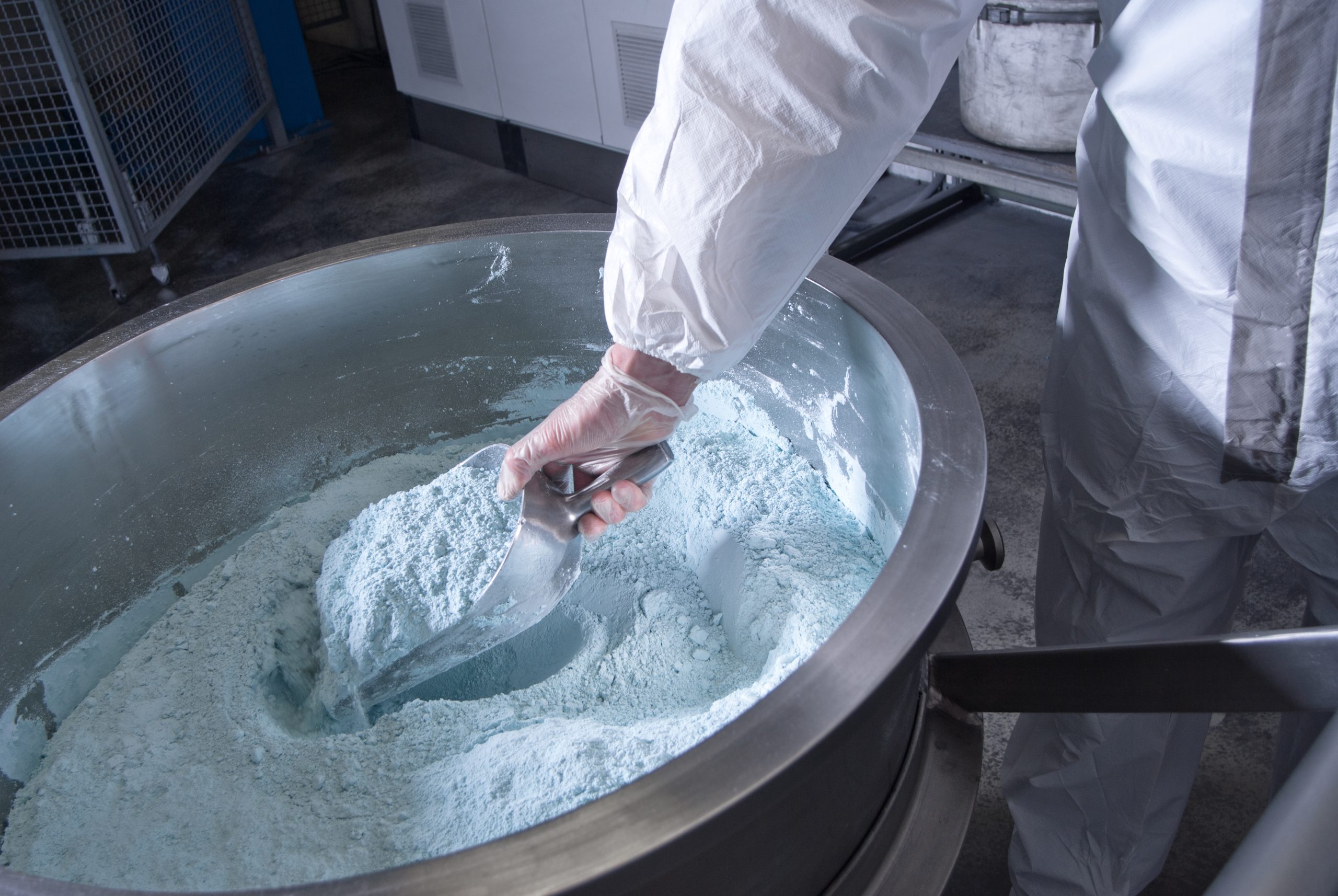
Use in pure form
PTFE in pure form
Virgin PTFE is processed and further manufactured in our company under the name NUE 1.
Key characteristics include:
- Temperature resistance from -200°C to +260°C
- High electrical insulating capacity
low coefficient of friction, without stick-slip effect - Pronounced anti-adhesive behavior
physiologically harmless (FDA- and BfR-compliant) - Excellent weathering and aging resistance
- No water absorption
- Low thermal conductivity
- Extremely low tendency to burn (UL 94 (at 1.5 mm): VO, LOI index: 95%)
- PTFE can be used in vacuum applications
For pure PTFE, please note:
- Not processable by injection molding
- Relatively low wear resistance; if required, the use of PTFE compounds should be considered
- High tendency to cold flow
- Low resistance to high-energy radiation; polymer properties change from a radiation dose of 10 kGy
- Poor bonding properties
Modified use
Modified PTFE
Chemically modified PTFE – NUE M 1 – significantly enhances the positive properties of NUE 1 through a modifier incorporated into the polymer chain:
- Lower tendency to cold flow (deformation under load)
- Denser, less porous structure
- Improved recovery behavior
- Improved welding behavior
- Smoother surfaces and higher transparency
In addition, special partially modified material types for dynamic loads allow optimal component tuning in terms of compressive creep and stress-rupture behavior. We will be pleased to advise you!
Custom PTFE compounding
Compounds
PTFE compounds are produced by mixing fillers into the PTFE base polymer. The aim is to optimize material properties for specific application requirements. Fillers are primarily used to:
- Reduce cold flow (deformation under load)
- Increase wear resistance
- Increase electrical conductivity and thermal conductivity, and
- Reduce thermal expansion
In addition, incorporating special pigments also enables PTFE materials to be colored—for example, for visual differentiation of similar parts or as a marketing aid.
Fillers
| Property | GLASS | CARBON | BRONZE | GRAPHITE |
| Density | • | ⚬ | • | ⚬ |
| Tensile strength | ⚬ | ⚬ | ⚬ | ⚬ |
| Elongation at break | ⚬ | ⚬ | ⚬ | ⚬ |
| Ball indentation hardness | • | • | • | • |
| Compressive strength / deformation under load | • | • | • | • |
| Wear resistance | • | • | • | • |
| Coefficient of friction | • | • | • | • |
| Thermal expansion | ⚬ | ⚬ | ⚬ | ⚬ |
| Operating temperature range | ⚬ | ⚬ | ⚬ | ⚬ |
| Thermal conductivity | ⚬ | • | • | • |
| Electrical conductivity | ⚬ | • | • | • |
| Dielectric strength | ⚬ | ⚬ | ⚬ | ⚬ |
| Porosity | • | • | • | • |
| Chemical resistance | ⚬ | ⚬ | ⚬ | ⚬ |
| • increased | ⚬ reduced | ⚬ unchanged | ||
From analysis to the finished product
Our development process
We provide consulting, development, manufacturing, and testing to reduce your development risks and ensure an optimal process.
Application consulting & analysis
We advise you on material and component selection, taking your operating conditions into account, and develop a solution approach.
Planning & material selection
A preselection is made from a large number of proven standard and special compounds or based on a customer-specific new development.
Component design
The structural design of the components is carried out according to material, functional, and installation specifications. We combine many years of design know-how with modern FEM calculations.
Quality testing
The previously theoretical design is verified and optimized through various component-specific test bench tests.